The Winter Car Emergency Kit: A Complete Checklist
A winter breakdown is a safety situation, not just an annoyance. Here is how to build a winter car emergency kit — pre-made or DIY — with a full checklist and stay-safe basics.
This article contains affiliate links — if you buy through them, we may earn a commission at no extra cost to you.
Short answer: Pack a charged jump starter (with jumper cables as backup), an escape tool, a portable tire inflator, sand or cat litter and a folding shovel, an emergency blanket with a spare hat, gloves and hand warmers, reflective triangles or LED flares, and a flashlight or headlamp. Round it out with a first-aid kit, water and snacks, and a phone charger or power bank. You can buy a ready-made kit or build your own; the full checklist is below.
Updated October 2026.
A winter breakdown is a different animal than a summer one. A flat on a July afternoon is an annoyance; the same flat at night in January, on a cold shoulder, is a genuine safety situation. The gap between those two outcomes is usually just a box of gear in the trunk. A proper winter emergency kit will not prevent trouble, but it turns being stranded from a crisis into a manageable wait — and that is the whole point.
No spam. Unsubscribe anytime.
Here is how to put one together, whether you buy a ready-made kit or build your own, plus a complete checklist and the stay-safe basics that matter most when the temperature is below freezing.
One Unit for the Jump Starter and the Inflator
Two items on the checklist below, the charged jump starter and the portable tire inflator, can come from a single box. The VTOMAN X7 is listed as a 4250A jump starter for 12V gas and diesel engines up to 10L, with up to 70 starts per charge and an inflator listed at up to 160 PSI with a PSI, BAR or KPA readout. Its listing gives an operating range of -4°F to 140°F and a 400-lumen light with red flash and SOS modes. The box is listed with smart jumper cables, an air hose and five nozzles, plus an 18-month warranty, and the listing says to let the pump cool for a few minutes if it gets hot. Check the current price on Amazon.
Pre-Made Kit or Build Your Own?
There are two honest paths here. A pre-made roadside kit gets you covered today, in one purchase, with the basics organized in a case instead of rolling loose around the trunk. Something like the Haiphaik car emergency kit bundles the core roadside items — including a set of nearly 12-foot jumper cables long enough to reach when you cannot line the cars up nose-to-nose — into a single grab-and-go bag. For most people, that is the fastest way to go from nothing to reasonably prepared.
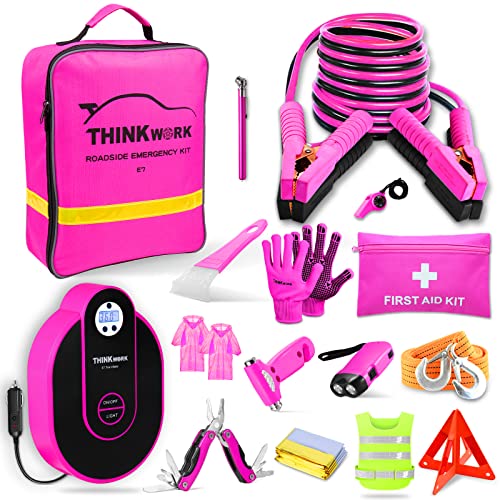
A pre-made kit also makes a genuinely useful gift, especially for a new or young driver who would never assemble one on their own. The Thinkwork car emergency kit is put together and marketed with exactly that new-driver gift in mind, which makes it an easy, practical present for the teenager or first-car owner in your life. The best safety gear is the kind that actually ends up in the car, and a giftable kit clears that bar.
Building your own costs a little more effort but lets you tailor the kit to your climate and your vehicle, and to buy better versions of the pieces that matter most. Plenty of drivers do both: start with a pre-made kit, then upgrade and add to it. The sections below are the pieces worth prioritizing either way.
Jumper Cables and a Jump Starter
A dead battery is the single most common cold-weather failure, so this is where to start. Jumper cables are the classic answer, but they have a catch: they need a second running vehicle and someone willing to stop. That is why a self-contained jump starter has become the smarter primary tool. A compact lithium pack like the NOCO Boost GB40 can start most cars on its own, with no good samaritan required, and its spark-proof connections make it far more forgiving to use than bare cables in the dark.
For bigger engines and trucks, the GOOLOO GT Truck PRO review covers a 10,000A pack, and the WOLFBOX MV10A review and VTOMAN X7 review cover packs that also carry an air compressor.
Carry both if you can. The jump starter is your first move, and the cables are the backup for the day the pack is flat or the battery is truly dead. Redundancy is good insurance in the cold.
The Escape Tool You Hope You Never Use
Some gear justifies itself on the one-in-a-thousand day. A window-breaker and seatbelt-cutter — a compact emergency escape tool — is exactly that. If a seatbelt jams or a door will not open after a slide-off, this small tool gets you out. It cuts a stuck belt and shatters a side window in seconds.
Keep it somewhere you can actually reach while belted into your seat — a door pocket or center console, not buried in the trunk. An escape tool locked in the back is no escape tool at all. This is a small piece of hardware standing between a bad situation and a much worse one.
Air and Traction
Cold air lowers tire pressure, and a slightly soft tire in winter handles worse and is more prone to trouble. A portable inflator earns its keep here. A compact 12V unit like the AstroAI AirUn H tire inflator lets you top off a low tire in a parking lot or on the shoulder without hunting for a working gas-station pump, and it can reseat a slow leak enough to limp to a repair shop.
If you would rather carry a cordless inflator, the GOOLOO GT150 review covers a 150 PSI battery unit.
For traction, throw in a bag of sand or cat litter and a folding shovel. If you get stuck in snow, a little grit under the drive tires and a cleared path in front of them will get most vehicles moving again. These items cost almost nothing and are exactly what you will wish you had the one time you need them.
Warmth and Visibility
If you are stranded in the cold, warmth is survival gear, not a comfort. Pack a wool or emergency blanket, a spare hat and gloves, and a few chemical hand warmers. If you keep the engine off to save fuel — or if it will not run at all — those items are what keep you comfortable and safe while you wait for help.
Visibility keeps you from becoming a second accident. Winter nights are long, and plows and other drivers may not pick out a stalled car until they are close. Pack reflective triangles or LED flares to set out behind the vehicle, and a good flashlight or headlamp with fresh batteries. Being seen is half of staying safe on a winter shoulder.
Two Habits That Prevent Half the Trouble
Gear matters, but two free habits head off a lot of winter breakdowns before they start. First, keep your fuel tank at least half full through the cold months. A fuller tank gives you more hours of engine heat if you are ever stranded, and it helps keep condensation and fuel-line freeze at bay. Second, on any bad-weather drive, tell someone your route and your expected arrival time. If you do slide off into a ditch on a quiet road, the fastest rescue is often the person who knew where to start looking. Neither habit costs a dime, and together they turn most winter scares into minor ones.
The Complete Winter Kit Checklist
Use this as your build-or-check list:
- Jump starter, charged, plus jumper cables as backup
- Escape tool (window breaker and seatbelt cutter), within reach of your seat
- Portable tire inflator
- Sand or cat litter for traction, and a folding shovel
- Ice scraper and snow brush
- Emergency blanket, spare hat and gloves, hand warmers
- Reflective triangles or LED flares
- Flashlight or headlamp with spare batteries
- First-aid kit
- Drinking water and a few non-perishable snacks
- Phone charger or power bank
- Basic tools, a tow strap, and duct tape
- A small stash of any essential medications
Stay-Safe Basics
If you do get stranded in winter, the single best rule is usually to stay with your vehicle. It is shelter, it is far easier for rescuers to spot than a person on foot, and walking for help in a storm is how people get into real danger. Call for help, then wait where you are.
If you run the engine for heat, run it in short intervals and make absolutely sure the exhaust pipe is clear of snow first. A tailpipe packed with snow can push carbon monoxide back into the cabin, which is silent and deadly — crack a downwind window slightly whenever the engine is running. Keep your dome light or hazards on to stay visible, bundle up before you get cold rather than after, and protect your phone battery for the call that matters.
FAQ
What should be in a winter car emergency kit?
Start with a charged jump starter plus jumper cables as backup, an escape tool within reach of your seat, a portable tire inflator, sand or cat litter and a folding shovel for traction, and an ice scraper and snow brush. Add an emergency blanket, spare hat and gloves, hand warmers, reflective triangles or LED flares, a flashlight or headlamp with spare batteries, a first-aid kit, water and snacks, a phone charger or power bank, basic tools with a tow strap and duct tape, and any essential medications.
How do I prep a winter car emergency kit?
Decide whether to start with a pre-made kit or build your own, then fill in the pieces in priority order: a jump starter and jumper cables, an escape tool, an inflator and traction aids, then warmth and visibility. Keep the escape tool where you can reach it while belted in, keep your fuel tank at least half full through the cold months, and tell someone your route and expected arrival time on any bad-weather drive.
Can I make my own winter emergency car kit instead of buying one?
Yes. Building your own takes a little more effort but lets you tailor the kit to your climate and your vehicle and buy better versions of the pieces that matter most. Plenty of drivers do both: they start with a pre-made kit, then upgrade and add to it.
Sources
Specifications quoted in this guide come from the title, brand and feature bullets of the Amazon listings below.
- Amazon product listing for the VTOMAN X7 Jump Starter with Air Compressor.
- Amazon product listing for the HAIPHAIK Car Emergency Kit with 11.8ft Jumper Cables.
- Amazon product listing for the THINKWORK Car Emergency Kit for Teen Girl and Lady's Gifts.
- Amazon product listing for the NOCO Boost GB40 12V 1000A UltraSafe Portable Lithium Jump Starter.
- Amazon product listing for the Amazon Basics Emergency Escape Tool.
- Amazon product listing for the AstroAI AIRUN H Tire Inflator Portable Air Compressor.
Affiliate Disclosure