The Best Cold-Weather Jump Starters for 2026
Cold weather is when batteries die. Here are the best jump starters for winter 2026 — from a glovebox commuter pack to truck-sized muscle and a budget high-capacity option.
This article contains affiliate links — if you buy through them, we may earn a commission at no extra cost to you.
Cold weather is when batteries go to die. A battery that cranked fine all summer can leave you stranded on the first truly frigid morning, because the chemistry that produces cranking power slows way down in the cold — right when your engine, full of thick cold oil, is asking for more of it. That is why a good jump starter is one of the smartest things you can keep in the vehicle over winter. It turns a dead-battery morning from a tow-truck wait into a two-minute inconvenience.
This is a winter buyer's guide, so we are ranking these by the job they need to do in the cold, from a compact commuter pack to shop-grade muscle. First, a little on why the cold is so hard on batteries, and how much cranking power you actually need.
Why Batteries Quit in the Cold
No spam. Unsubscribe anytime.
Two things gang up on you in winter. First, a battery simply cannot deliver as much current when it is cold — a battery near 0°F may have only about half the cranking punch it does on a warm day. Second, cold engine oil is thick and stubborn, so the starter has to work harder and draw more power to spin the engine over. Less supply, more demand: that is the squeeze that kills batteries in January.
A battery that is already a few years old, or that has been slowly drained by short trips and parasitic draws, is living on borrowed time once the cold arrives. A jump starter does not fix a bad battery, but it does mean a weak one cannot ruin your morning.
How Much Cranking Power You Actually Need
Jump starters are rated in peak amps, but the practical question is engine size. As a rough rule of thumb, a small four-cylinder is easy to start and needs the least; a big V6 or a small V8 wants a solid mid-range unit; and a large V8, a heavy truck, or a diesel needs serious current, especially when it is cold. Diesels are the hungriest of all because of their high compression and, often, two batteries.
The honest move is to buy more capacity than your engine needs on a mild day, because winter erases part of your margin. A pack that is barely adequate in October can come up short at 10°F. Size up, and you buy yourself insurance for the worst morning of the year rather than the average one.
Lithium or Lead-Acid in Freezing Weather
Almost every modern portable jump starter is lithium — compact, light, and small enough to live in a glovebox or door pocket. The trade-off is that lithium cells lose output in extreme cold and do not love being stored at freezing temperatures for months, which is the caveat we come back to at the end. For most drivers the convenience wins, and you simply bring the pack inside on the coldest nights.
The old-school alternative is a lead-acid booster pack — heavy, bulky, but proven. The professional-grade example is the Clore JNC660, a shop-grade lead-acid unit that mechanics have leaned on for years; it shrugs off hard use and delivers big cranking current, though it is far too large to tuck away and needs periodic recharging to stay ready. If you are outfitting a garage or a fleet rather than a glovebox, that is the class of tool to look at. For everyone else, the lithium packs below are the answer.
The Everyday Commuter Pick
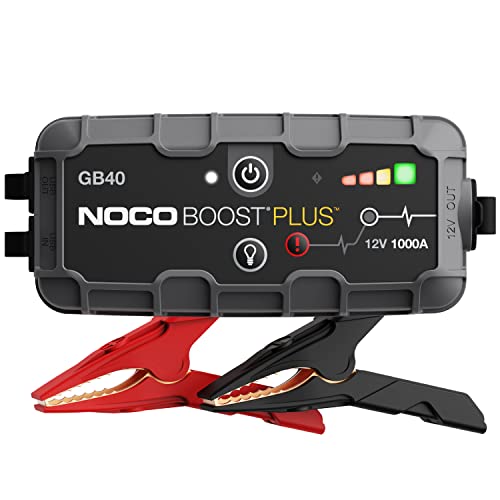
For a typical car, crossover, or small SUV, the NOCO Boost GB40 hits the sweet spot. It is a 1000-amp lithium pack small enough to keep in the glovebox yet with the guts to start most gas engines, and NOCO's UltraSafe design adds spark-proof connections and reverse-polarity protection — a real reassurance when you are clipping cables onto a cold battery in a dark parking lot with numb fingers.
This is the one I point most commuters to. It covers the common case, it is genuinely pocketable, and the safety features mean you are unlikely to hurt yourself or your car even if you fumble the hookup. For a daily driver, it is hard to do better for the money.
For Trucks and Big V8s
Step up to a full-size truck, a big V8, or a diesel and you want more muscle. The NOCO Boost GB70 doubles the peak output to 2000 amps, which is the headroom a large or high-compression engine needs to spin over on a bitter morning. It carries the same UltraSafe protections as its smaller sibling, just in a bigger, more powerful package.
If you tow, plow, or drive a diesel, do not talk yourself into the smaller unit to save a few dollars. Cold plus displacement plus, often, dual batteries is exactly the scenario that overwhelms an undersized pack. The GB70 is built for that job.
The One with a Built-In Air Compressor
A dead battery and a low tire tend to show up in the same cold snap, and the GOOLOO A3 covers both. It is a jump starter with an integrated air compressor, so the same box that gets your engine running can also reinflate a tire that lost pressure overnight — and tires always read low in the cold. For anyone who does not want to carry two separate tools, the two-in-one design is genuinely handy.
Combining functions like this is smart winter packing. Trunk space is finite, and a unit that jump-starts the car and airs up a soft tire earns its spot where two single-purpose gadgets might not.
The Rugged, Take-It-Anywhere Pick
If your idea of winter involves a trailhead, a job site, or a cabin at the end of a bad road, look at the LOKITHOR J400. It is built tough for the kind of use that would beat up a lighter consumer pack, aimed at drivers who need a jump starter that can ride around in a truck-bed toolbox and still fire when called on.
Ruggedness is an underrated feature in a winter tool. The pack that lives in a work truck takes a beating — cold, vibration, the occasional drop — and a unit built to survive that is worth more than one with a slightly bigger spec sheet that cracks the first hard winter.
The Budget High-Capacity Pick
Want a lot of cranking capacity without spending top dollar? The DBPOWER 3000A jump starter leads with a high peak-amp rating and a large 18000mAh battery, so it has the reserve to handle bigger engines and to double as a hefty power bank for charging phones and devices — useful if you are ever stuck waiting out a storm.
Value picks always involve some trade-offs against premium brands, but for a driver who wants maximum stated capacity per dollar and a big reserve to lean on, this is a sensible place to look.
Keeping It Alive Through Winter
Whatever pack you choose, keep it charged. A jump starter that has been sitting dead in the trunk since last spring is no help at all, so top it off at the start of the season and check it every month or so. And mind that lithium caveat: on the very coldest nights, a lithium pack delivers its best when it has not been sitting out in the deep freeze, so bringing it indoors now and then keeps it at full strength for the morning you actually need it.
Affiliate Disclosure