Battery Maintainers for Winter Storage: A Plain-English Guide
Park a vehicle for winter and the battery can be dead by spring. Here is why stored batteries die and how a smart maintainer with float mode keeps them ready.
This article contains affiliate links — if you buy through them, we may earn a commission at no extra cost to you.
You park the project car, the motorcycle, the RV, or the second truck for the winter, walk away in November, and come back in April to a dead battery and a no-start. It is one of the most common — and most avoidable — headaches in the garage. The fix is cheap, simple, and mostly a matter of understanding why a parked battery dies in the first place and what kind of charger actually prevents it.
This guide covers why stored batteries fail over winter, the real difference between a trickle charger and a smart maintainer, how to size one, the AGM setting people overlook, and how to hook it up without making a spark next to a battery.
While the car hibernates, it's also the right moment to get the rest of the bay in order — commercial-grade wire shelving from Shelving Inc. keeps maintainers, fluids, and seasonal gear off the floor, and code WIRESTORAGE10 takes 10% off. The title, the spare key fob, and the winter's receipts for the project car need a home too — a small bolted-down garage safe keeps them out of the glovebox of a car nobody is watching for the whole winter.
No spam. Unsubscribe anytime.
One more piece of winterizing the bay is the door itself — the easiest thing to leave open by accident and the one that undoes the rest. A smart controller like the Meross MSG200 retrofits onto the opener you already have and adds open-door alerts plus auto-close scheduling, so a stored vehicle is not left sitting behind a door raised overnight, open to the weather and to anyone walking past. You can check or shut it from your phone instead of trekking out to the garage, it works with HomeKit, Alexa, Google Home, and SmartThings, and a single unit runs up to three doors — the non-HomeKit MSG200 lands around $40.
Why a Parked Battery Dies Over Winter
A battery does not need to be doing anything to go flat. Every lead-acid battery self-discharges a little every day just sitting there, and modern vehicles make it worse: clocks, alarms, keyless-entry receivers, and control modules all sip a small parasitic current around the clock even with the key out. Over a few months of storage, those tiny draws add up until the battery is flat.
Cold makes the whole thing worse in two ways. A battery loses capacity as the temperature drops, so it has less in reserve to begin with. And here is the part that ruins batteries for good: a fully charged battery can shrug off deep cold, but a discharged one can freeze solid, cracking the case and destroying it. On top of that, a battery left sitting discharged sulfates — hard crystals build up on the plates and permanently rob it of capacity. Leave a battery flat all winter and you are often shopping for a new one in spring.
Trickle Charger vs Smart Maintainer
People use these terms interchangeably, but they are not the same, and the difference matters. A basic trickle charger pushes a constant low current into the battery for as long as it is plugged in. That is fine for a short top-up, but leave it connected for months and it keeps pushing after the battery is full, slowly overcharging it, boiling off electrolyte, and shortening its life. A trickle charger is not meant to be left unattended all winter.
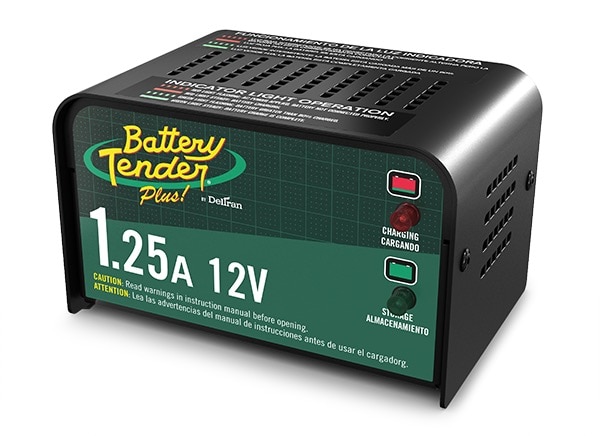
A smart maintainer — sometimes called a battery tender — is the tool you actually want for storage. It monitors the battery's voltage and only feeds it power when it needs it, then drops into float mode: a maintenance trickle that holds the battery at a perfect full charge without overcharging. That float-mode logic is the whole game. It is what lets you connect a battery maintainer for stored vehicles in November, plug it into the wall, and walk away until spring knowing the battery will be at full strength and ready when you turn the key.
Sizing the Amps
Maintainers are rated in amps, and for pure storage duty you do not need much. A unit in roughly the 0.75-amp to 2-amp range is plenty to offset self-discharge and parasitic draw and keep a healthy battery topped off through the winter. That is the maintaining job, and small is fine.
Charging is a different task from maintaining. If you expect to bring a deeply drained battery back to life quickly, you want more amperage than a pure maintainer provides. For most people storing a good battery over winter, though, a low-amp smart maintainer is exactly the right tool — sized to hold, not to rush. Match the tool to the job and you will neither overspend nor come up short.
If you are keeping more than one vehicle asleep for the winter, you have two options: buy a maintainer for each, or move a single unit between them on a rotation, giving each battery a few days on the charger every couple of weeks. A dedicated unit per vehicle is the true set-and-forget choice, and they are inexpensive enough that many people simply leave one permanently wired to each stored car, with the pigtail connector tucked where they can reach it without even opening the hood.
The AGM Setting
Not all batteries charge the same way. Traditional flooded lead-acid batteries and the newer AGM (absorbent glass mat) type have slightly different ideal charging voltages, and feeding an AGM battery the wrong profile over a long period can shorten its life. Many modern vehicles, powersports machines, and premium batteries are AGM, so this is not a niche concern anymore.
The fix is easy: use a maintainer with an AGM mode and select it if your battery is AGM. If you are not sure what you have, the battery label or your owner's manual will say. It is a ten-second setting that makes sure the maintainer is speaking your battery's language rather than slowly cooking it.
What About a Solar Maintainer?
If your stored vehicle sits somewhere without a nearby outlet — a gravel lot, a storage yard, a spot at the back of the property — a solar battery maintainer is worth a look. A small panel on the dash trickles just enough charge to offset self-discharge, and the good ones use the same float-mode logic as a plug-in unit, so they will not overcharge on a run of sunny days. The trade-off is that output depends on the weather and the panel needs real light, so a maintainer parked in a dark garage is the wrong tool for the job. For a vehicle stored outdoors and off the grid, though, solar keeps the battery alive with no extension cord to run.
Hooking It Up Safely
A charging battery gives off a small amount of hydrogen gas, which is flammable, so the goal is to never create a spark right at the battery terminals. The order matters. With the maintainer unplugged from the wall, connect the positive (red) clamp to the positive terminal first. Then connect the negative (black) clamp to a clean, unpainted metal point on the frame or engine — a ground away from the battery — rather than directly to the negative post. Only after both clamps are on do you plug the maintainer into the wall.
To disconnect, do it in reverse: unplug from the wall first, then remove the negative clamp, then the positive. Work in a ventilated space, not a sealed closet, and keep the connections clean. None of this is hard; it is just the difference between a safe winter of hands-off charging and a careless spark next to a battery.
If You Forgot to Plug It In
Even with the best intentions, sometimes the maintainer does not get connected — you were in a hurry putting the car away, or you added a vehicle mid-winter. If you come out to a stored vehicle with a flat battery, a portable jump starter like the NOCO Boost GB40 will get it running so you can drive it, recharge it, and get the maintainer connected for next time. It is the belt-and-suspenders backup to the maintainer's prevention.
The better habit, of course, is to make plugging in the maintainer part of the same routine as covering the car. Prevention costs a few dollars and a minute of your time; a replacement battery every spring costs a lot more. Set it up once, and the car that was hardest to start becomes the one that always fires on the first try.
Affiliate Disclosure