Check Engine Light On but Car Runs Fine? Read the Code for $30
The car drives fine but the check engine light won't turn off. Here's how to pull the actual code yourself for about $30, and how to tell which codes need attention now.
Disclosure: This article contains affiliate links. If you buy through them we may earn a commission at no extra cost to you.
A lit check engine light with no other symptoms is common, and it's data, not a diagnosis
The check engine light is triggered by the onboard computer detecting that a sensor reading, or a pattern of readings, has fallen outside its expected range — not by a mechanic deciding your car is broken. Owners consistently report that the light comes on with zero drivability change: same power, same fuel economy, same everything. That's real, and it happens because plenty of trouble codes represent things like an evaporative-emissions leak or a marginal oxygen-sensor reading — issues that affect emissions compliance or long-term component wear well before they affect how the car drives.
That does not mean it's safe to ignore indefinitely. It means the light alone doesn't tell you whether you're looking at a $4 gas cap or a converter that's slowly failing. The only way to know the difference is to read the actual code, and that costs about $30 in tools you keep, versus a diagnostic fee at a shop every time it happens.
No spam. Unsubscribe anytime.
How to read the code yourself
- Locate the OBD2 port. On nearly every car sold in the US since 1996, it's a trapezoidal 16-pin port under the dashboard, usually left of the steering column.
- Plug in a code reader with the ignition on (engine can be off for this step).
- Pull the stored codes. A basic reader will show something like "P0442" — the letter-number code — often with a short generic description.
- Look up what the specific code means for your make and model, since the same P-code can have different common causes across different engines.
- Clear the light if you choose to, but note that if the underlying condition is still present, the light will come back within a few drive cycles — which is itself useful diagnostic information.
For this job, you don't need a professional-grade tool. A basic reader is built exactly for this:
- Check price on Amazon → — ANCEL AD310. A simple, handheld, no-subscription code reader with a strong ownership track record (65K+ ratings per the listing) — plug in, read the code, done.
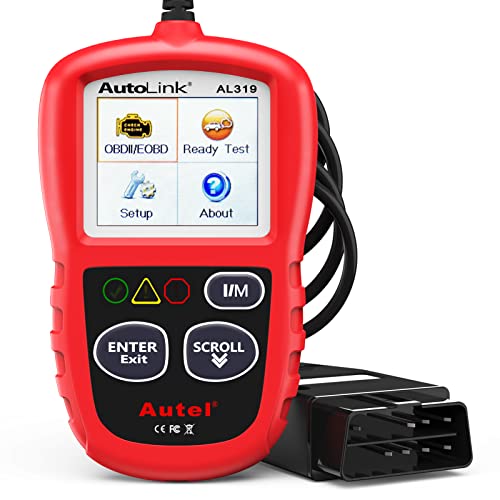
- Check price on Amazon → — Autel AL319. Similar category, another well-established handheld option if you want a second reputable brand to compare.
Both read the generic powertrain codes every car is required to expose — exactly the layer that covers the vast majority of "light's on, car feels fine" situations.
When it's reasonable to keep driving, and when it isn't
This is a hedge, not a diagnosis: nothing here replaces a mechanic looking at your specific car. That said, the general pattern owners and shops report:
- Steady (not flashing) light, no new noises, no power loss, no smell of fuel or burning — typically lower urgency. Common causes at this end include a loose or failing gas cap, an aging oxygen sensor, or a minor evaporative-system leak. Reading the code and scheduling a repair in the near term is usually reasonable.
- A flashing check engine light, or the light paired with a rough idle, a new smell, or a loss of power — this pattern is generally associated with an active misfire, which can send unburned fuel into the catalytic converter and cause expensive damage quickly. This combination is treated as a stop-and-get-it-checked situation, not a keep-driving-and-see one.
If you read a code and aren't sure which bucket it falls into, that's exactly the information to bring to a shop — you'll get a faster, cheaper diagnosis with a code number in hand than with just "the light is on."
Why the light can come back after clearing it
Clearing a code turns the light off immediately, but it does not fix whatever triggered it. The onboard computer runs the same monitoring routine on a schedule tied to your drive cycles, and if the underlying condition — a loose gas cap, a marginal sensor, a small leak — is still present, the light typically returns within a handful of trips. That's not the tool malfunctioning; it's the system doing exactly what it's designed to do. Owners sometimes clear a code before a smog check or before selling a car, not realizing the monitor has to complete several drive cycles to report "ready" again — showing up with unset monitors can fail an emissions inspection just as surely as an active code would.
A cheap first check worth trying before anything else
For the single most common cause of an intermittent, no-symptom check engine light — an evaporative-system code, commonly P0442 or P0455 — check the gas cap first. A cap that isn't fully seated, has a worn seal, or was swapped for a non-OEM cap that doesn't seal correctly is a frequent, well-documented trigger, per owner reports across nearly every make. Tightening or replacing a cap costs a few dollars and takes under a minute, and it's worth ruling out before assuming a more expensive component is at fault.
Beyond powertrain codes
A basic $30 reader only sees the powertrain layer — it won't catch a fault logged by the ABS, airbag, or transmission control modules. If your dash also shows an ABS or airbag warning light alongside the check engine light, that's a different tier of tool; see our guide to scanners that read ABS, airbag, and transmission codes. And if you're shopping for a reader and want to see how the ANCEL and Autel stack up against pricier options, our full comparison of scanners under $100 breaks down the capability tiers.
The bottom line
A check engine light with no other symptoms is worth reading, not panicking over. The ANCEL AD310 or Autel AL319 will pull the code for about the price of a fast-food order, and having the actual code — instead of just "the light is on" — is what turns a guess into a plan. Treat a steady light with no other symptoms as "read it, then schedule it"; treat a flashing light or one paired with new noise, smell, or power loss as "stop and get it checked."
Affiliate Disclosure