Best Dash Cams for RVs and Travel Trailers
Towing a trailer changes the dash cam math entirely — rear cable runs get long, vibration is constant, and 12V wiring works differently than a standard car.
Disclosure: This article contains affiliate links. If you buy through them we may earn a commission at no extra cost to you.
Why RV dash cam setups are different from a standard car
Towing a travel trailer changes three things about a dash cam install: the rear camera's cable has to run much farther (or you need a wireless rear solution), the whole rig sees more sustained vibration over long highway stretches, and your 12V wiring situation is split between a tow vehicle's factory circuits and the trailer's own often-separate electrical system. A dash cam bought for a sedan doesn't automatically translate to "front windshield of the truck, rear camera at the very back of a 30-foot trailer" — that's a cable run most kits were never designed for.
Rear camera cable-run limits
No spam. Unsubscribe anytime.
Most 2-channel dash cam kits ship with a rear camera cable in the 20-33 foot range, sized for mounting a rear camera at a sedan or SUV's back window. On a motorhome or a truck towing a trailer, the realistic mounting point for "rear visibility" is either the back of the tow vehicle (which is a reasonable, in-spec cable run) or the very back of the trailer itself, which is often 25-40+ feet farther than any included cable reaches.
For most RV and travel-trailer owners, the practical answer is to mount the rear camera at the back of the tow vehicle or motorhome cab, not at the rear of the trailer — this keeps you within the cable length included with standard 2-channel kits and still gives you following-traffic and backing footage. If you specifically need trailer-rear visibility (e.g., watching the load or catching a following vehicle's tailgating right at the trailer's bumper), you're looking at a separate backup-camera-style wireless system rather than extending a dash cam's rear cable, since extension cables beyond spec commonly introduce signal degradation on longer wired runs.
12V wiring: tow vehicle vs. trailer power
If you're wiring the dash cam into the tow vehicle (truck, SUV) hauling the trailer, standard hardwiring applies — see our fuse tap hardwiring guide for the safe install process into the vehicle's own fuse box. Do not attempt to power a dash cam off the trailer's 7-pin connector or trailer battery system if you're mounting the camera in the tow vehicle's cab — that circuit is designed for trailer running lights and brakes, not steady dash cam draw, and the trailer's power availability depends on the tow vehicle being connected and running anyway.
For a motorhome (a single vehicle, not a tow setup), the dash cam wiring is closer to a standard car install — hardwire into a constant-power fuse in the coach's cab fuse panel, same process as any other vehicle.
Vibration resistance matters more on long tows
Long highway hauls with a loaded trailer put more sustained vibration through the tow vehicle's cabin than typical daily driving, and a loosely-seated microSD card or a marginal adhesive mount that would hold fine in normal use can work itself loose over a multi-day tow. Favor a camera with a secure card-slot latch and re-check your mount adhesion (see our mount troubleshooting guide) before any long trip.
Picks for RV and tow-vehicle use
REDTIGER F7NP — GPS logging for route documentation
GPS-tagged footage is genuinely useful on long RV trips, both for insurance purposes if an incident happens somewhere unfamiliar and for reviewing your route afterward.
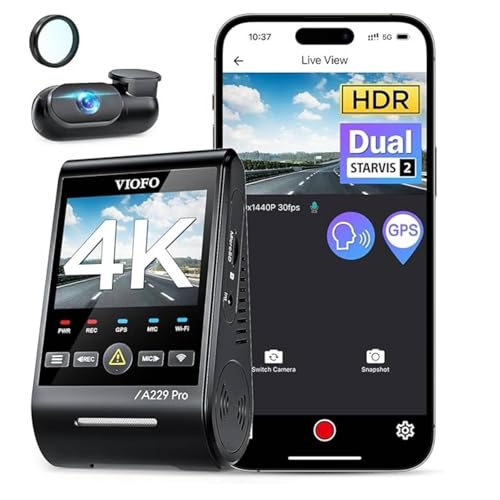
VIOFO A229 Pro — supercapacitor power for sustained heat and vibration
For a motorhome or truck that spends long stretches parked in direct sun between travel days, the VIOFO A229 Pro's supercapacitor power source resists the heat-driven battery swelling that a standard lithium battery camera can develop over repeated hot-soak cycles — see our supercapacitor vs. battery comparison for why that matters for anything that sits outdoors between trips.
Camera placement inside a motorhome cab
A Class A or Class C motorhome cab is a wider windshield than a typical car, and the mounting spot matters more than it does in a sedan because a poorly centered camera can end up with a distorted view of one side of the road. Center the camera as close to the middle of the windshield as your rearview mirror mount allows, and check the live preview through the camera's app before committing to adhesive, since repositioning after a VHB mount has fully bonded means damaging the mount to remove it. For toad-towed setups (a car towed behind a motorhome), a separate camera on the towed vehicle isn't standard practice — most owners rely on the motorhome's own rear camera plus periodic visual checks, since wiring a independent dash cam into a towed vehicle's electrical system while it's not running introduces its own power complications.
Storage considerations for long trips
Multi-week RV trips generate far more driving footage than a daily commute, and if you're also running parking mode during extended stops at campgrounds, storage fills up faster than most owners expect. A 128GB card, like the ones included with the ROVE R2-4K Dual and REDTIGER F7N Touch (both covered in our under-$150 roundup), gives meaningfully more days of buffer before older footage gets overwritten, which matters if you want a full trip's worth of driving history available rather than just the last day or two.
The bottom line
Mount the rear camera at the tow vehicle or motorhome's own rear window, not the back of the trailer, unless you're prepared to add a separate wireless system — standard dash cam rear cables aren't built for that distance. Hardwire into the tow vehicle or coach's own fuse box, never the trailer's 7-pin power. For RVers who park in direct sun between long tow days, the VIOFO A229 Pro's supercapacitor power source is the more durable long-term choice; for straightforward route documentation, the REDTIGER F7NP's GPS logging covers the basics well.
Affiliate Disclosure